How Art Keeps Its Value: Medium, Intent, Condition, and the Artist’s Practice
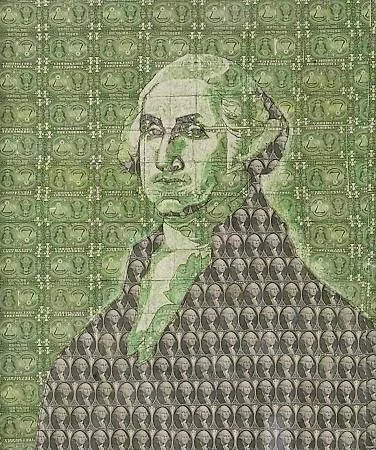
Ray Beldner. E Pluribus Unum (after Rembrandt Peale, George Washington, ca. 1854), 2005. Sewn US currency. Collection Fine Arts Museum of San Francisco.
Collecting artwork can be challenging and fun. For experienced and novice collectors alike, it's about aesthetics and personal value, the search for artwork that represents a collector's aesthetic and illustrates what she values. It’s a declarative emotional event colored by acquisitive desire and perceived value, two subjective elements that define personal aesthetic, or, in other words, “I want it” and “it’s worth it."
As an appraiser and art consultant, I receive a lot of questions about artwork value. Inquiries come in from clients about adding or reducing their collections, their new acquisitions, or from emerging artists asking about pricing their own work. Insurance companies, tax attorneys, and people who want to sell artwork after a loss (or damage) has occurred, or, when they prepare their estates, reach out to me for appraisals or opinions of value.
As an art consultant, the elements I use to judge value are objective. I look at the artist’s technical merit (choice of medium, skill, concept), condition, the artist's professional resume, and lastly, price. Professionally, an artwork’s value is dependent on a trifecta of factors: medium, making, and concept. What medium was used to make it, how was it made, and whether the artist’s ideas were successfully conveyed. Medium (the materials artwork is made of) is important to consider the life of the artwork in terms of its conservation (and related costs). Knowing what an artwork is made of determines how to care for it under various conditions (for example: is it an oil painting on canvas or paper), and medium is the first informative element the artist gives us to keep his work pristine and protected from age and deterioration. Technical merit, or mastery of the medium, is the skill employed by the artist when making the work. It's a measure of the artist's creative and making process, and defines how well made it is. Mastery is the third step: considering the artist's intent, or underlying concept — did the artist successfully convey his ideas?
As an appraiser, when determining value for works of art, the first measure I look at is condition, or how perfect is the work compared to the original state it was in at the time it was bought. This is when it’s assessed for damage or renewed value. Damage can take many forms, and when determining value, it’s defined by any event taking place after the artwork’s sale that changed the original nature of the artwork when it was offered for sale. The damage could be as small as a tear to a work on paper or canvas, smoke or faded colors, or in the case of sculpture, a break or crack. For work based on multiple pieces, a single missing piece in an otherwise perfect set creates loss. Damaged artwork is a reduced in value because it possesses change to the work so that doesn’t match the artist’s original artwork, making it less perfect. Renewed value is what we always hope for, that over the course of time, the artwork has increased in value and is worth more than its original price.
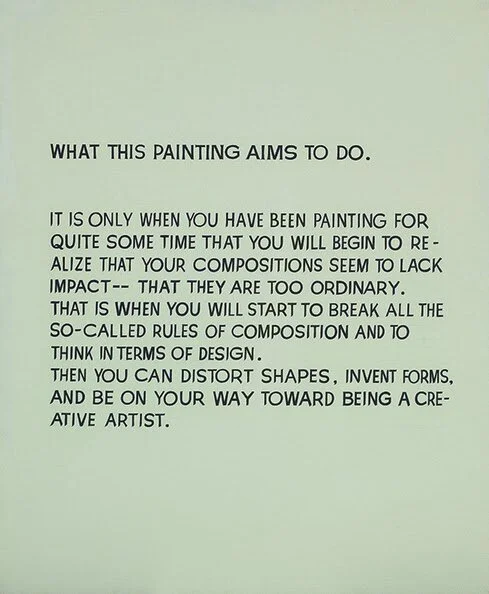
John Baldessari. WHAT THIS PAINTING AIMS TO DO, 1967. Acrylic on canvas, 67.7 x 56.5 in
My second measure for value is the artist. Has he maintained his practice, or was he a one hit wonder? Does his work continue to be sold in galleries and is it shown at exhibitions? Can his work be found in important collections and museums? Does his work demonstrate a trajectory of professional growth in terms of creative process? If the artist is retired, has his work been shown at auction and if so, has it retained or grown in value? Can the dealer who represented the artist, or sold the artwork represent it for resale or resell it on your behalf? These are the true elements of an artist’s resume — his work’s valuation trajectory and what determines price. It’s important for artists who wish to retain value to consider how they sell their work, and for collectors to consider how they acquire artwork to maintain the value of their collection.
Good work is always defined by a set of standards, and its final price is the price what brings it home. Collecting artwork is the acquisition of luxury. It won’t feed your children or protect you from the elements — but it nourishes the soul and, if you’re lucky, it will give you pleasure — it will be special, worthy of care, protection from theft and damage. Until it's time to sell.
And there’s a thought for another day.